RPZ Explained
Response Policy Zones enable Protective DNS by enforcing security policies directly inside recursive DNS resolvers.
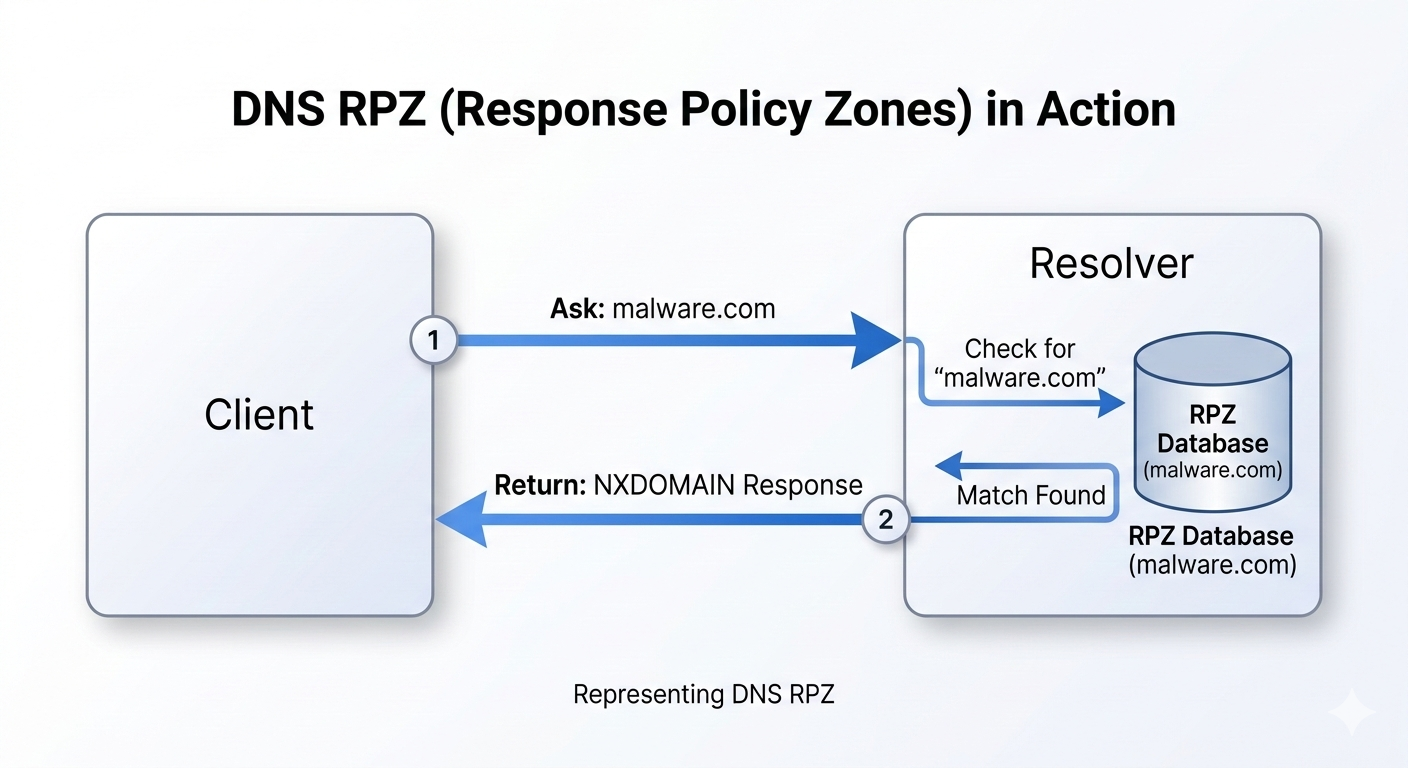
Response Policy Zones enable Protective DNS by enforcing security policies directly inside recursive DNS resolvers.
Response Policy Zones (RPZ) is a DNS technology that allows recursive DNS resolvers to apply security policies when answering DNS queries. Instead of returning the normal DNS response received from authoritative servers, the resolver can modify the response based on locally configured rules.
This capability enables the implementation of Protective DNS, allowing organizations, Internet Service Providers, and cybersecurity platforms to block malicious domains before users connect to them.
RPZ is commonly used to stop access to domains associated with:
When a user attempts to access a domain, their device sends a DNS query to a recursive resolver. If the resolver has RPZ enabled, the query is compared against policy zones that contain threat intelligence data.
If the queried domain matches a rule in the RPZ database, the resolver can apply different actions:
These actions prevent users from connecting to malicious infrastructure even if their devices attempt to access dangerous domains.
The following example shows a simplified configuration where a BIND recursive resolver loads an RPZ policy zone.
response-policy {
    zone "rpz.malware";
};

zone "rpz.malware" {
    type master;
    file "/etc/bind/rpz/malware.rpz";
};
The zone file contains rules for domains that should be blocked or modified by the resolver.
Many cyberattacks rely on domain names to operate. Malware frequently contacts command-and-control servers, phishing campaigns redirect victims to fraudulent websites, and botnets communicate with remote infrastructure through DNS.
By blocking malicious domains at the DNS layer, RPZ can stop threats before connections are established, providing a powerful security control point for networks.
Response Policy Zones are most effective when combined with continuously updated threat intelligence feeds. These feeds contain domains and indicators associated with malware campaigns, phishing operations, botnet command-and-control infrastructure, cryptomining malware, and other malicious activity observed across the Internet.
RPZ is often used as the foundation for DNS Firewall and Protective DNS services, where threat intelligence feeds continuously update policy zones with newly discovered malicious domains.
Threat intelligence sources may include:
These feeds are typically converted into RPZ policy zones and distributed to DNS resolvers, allowing security teams to block newly discovered malicious infrastructure very quickly.
Protective DNS refers to the use of DNS infrastructure to prevent users and devices from connecting to malicious or unsafe destinations on the Internet.
Instead of relying solely on endpoint security software, Protective DNS places security controls directly inside recursive DNS resolvers. Because every Internet connection begins with a DNS query, this allows security policies to stop many threats before a connection to a malicious server is established.
RPZ provides the technical mechanism that enables this capability. By applying policy rules during DNS resolution, the resolver can block or redirect requests to known malicious domains.
Protective DNS is widely deployed in:
Large organizations and Internet Service Providers often deploy RPZ-enabled DNS resolvers to provide network-wide protection for thousands or millions of users.
Because DNS resolution occurs before most Internet connections are established, DNS filtering provides an efficient control point for stopping access to dangerous infrastructure across an entire network.
Typical use cases include:
Many modern DNS security platforms combine RPZ with additional technologies such as DNSSEC validation, encrypted DNS protocols (DoT, DoH, DoQ), and real-time threat intelligence analytics to create comprehensive DNS security solutions.