What is DNS Anycast?

DNS Anycast is a routing architecture used by modern DNS infrastructures where multiple servers distributed across the world share the same IP address.

When a user sends a DNS query to that IP address, the Internet routing system automatically directs the request to the nearest or most optimal DNS server node.

This technique dramatically improves DNS performance, reliability, and resilience, and is widely used by large DNS providers, root DNS servers, and global Protective DNS platforms.
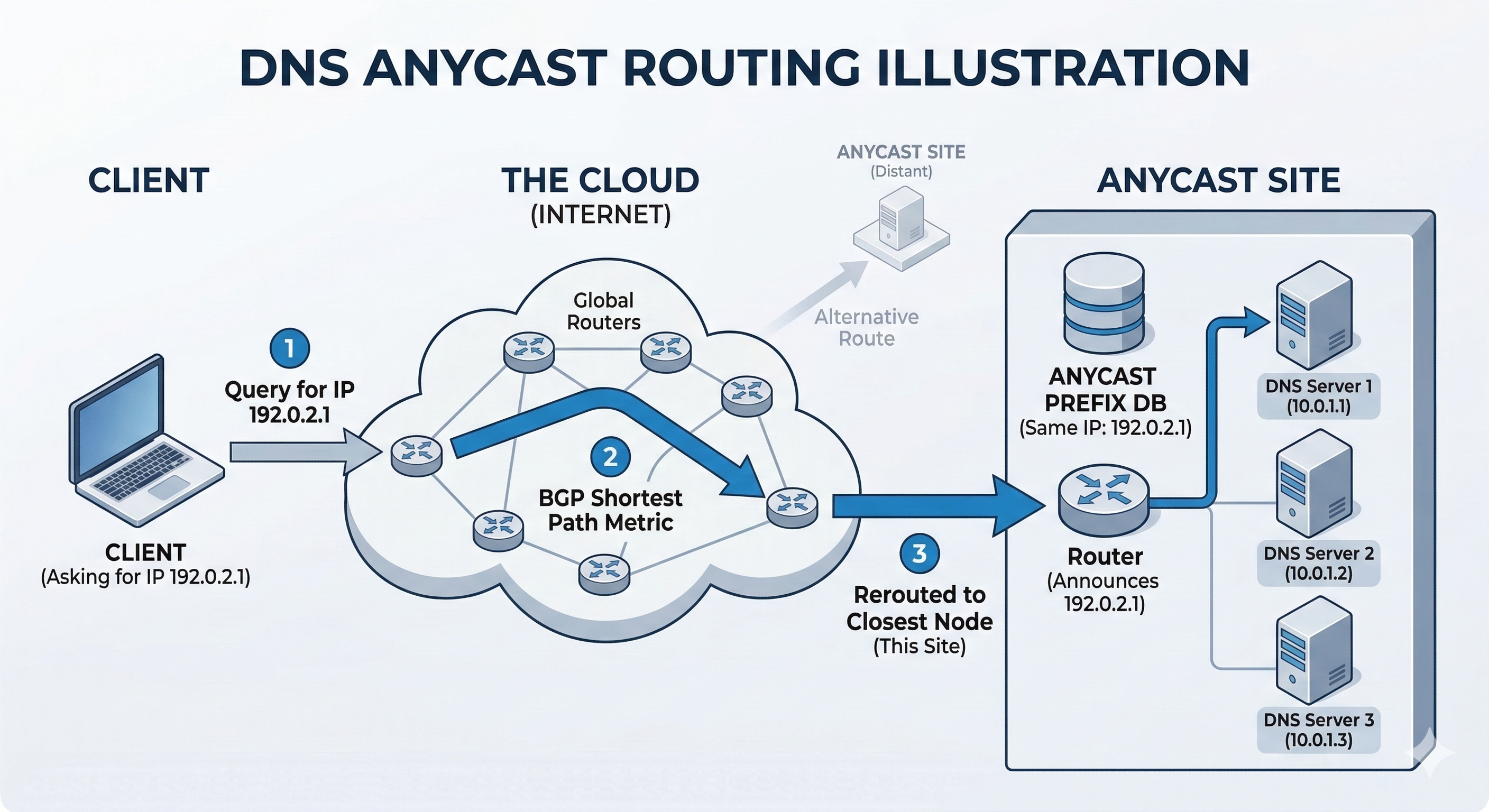
DNS Anycast infrastructure diagram

How DNS Anycast Works

In a traditional DNS setup, a single server or small cluster answers queries for a DNS resolver or authoritative zone. With Anycast, many geographically distributed servers advertise the same IP address using BGP (Border Gateway Protocol).

Routers across the Internet determine the best path to reach that IP address and automatically send the DNS query to the closest available node.

This means the same DNS IP address can simultaneously exist in many different data centers around the world.

Benefits of DNS Anycast

Because DNS queries are handled by the nearest available node, Anycast significantly reduces response times and improves the overall stability of DNS resolution.

DNS Anycast and Global DNS Infrastructure

Many large DNS providers operate global Anycast networks with dozens or even hundreds of DNS nodes deployed in Internet Exchange Points (IXPs) and major datacenters.

These nodes advertise the same DNS IP addresses using BGP, allowing Internet routing to dynamically determine which node should answer each query.

The DNS root server system, major public resolvers, and large authoritative DNS providers all rely heavily on Anycast to scale globally.

However, Anycast is not limited to hyperscale infrastructures. Internet Service Providers, telecommunications operators, universities, and enterprises can also deploy Anycast with just two or three datacenters. By announcing the same DNS IP address from multiple locations, organizations can improve resilience, reduce latency, and ensure that DNS services remain available even if a site or network segment becomes unavailable.

Even within a single facility, Anycast can be used across multiple network cabinets or racks to provide additional redundancy and simplify failover between DNS servers.

DNS Anycast and Protective DNS

Protective DNS platforms and DNS firewall infrastructures frequently use Anycast to distribute filtering and security capabilities across multiple locations.

When threat intelligence feeds update DNS policies — such as RPZ zones that block malware or phishing domains — those policies can be replicated across all Anycast nodes.

This allows security policies to be enforced globally while maintaining low DNS latency for users.

Anycast vs Unicast DNS

With Unicast, clients must manually choose which DNS server to query. With Anycast, Internet routing automatically sends the query to the optimal server location.

Summary

DNS Anycast is a fundamental building block of modern Internet infrastructure. By allowing many DNS servers to share the same IP address, it provides faster responses, higher availability, and greater resilience against failures and attacks.

This architecture is widely used by global DNS providers, root DNS servers, CDNs, and Protective DNS platforms that require highly reliable DNS resolution at Internet scale.

Related DNS Security Topics

Request Information

captcha
Can't read it? Click refresh
Planisys 2025 © All rights reserved.